
The cuts that define a great Japanese sashimi restaurant
You know the difference between a Japanese restaurant that understands fish and one that merely serves it. It's not the...
You know the difference between a Japanese restaurant that understands fish and one that merely serves it. It’s not the lighting. It’s not the playlist. It’s the sashimi.
No rice. No searing. No sauce to hide behind. Just the fish, sliced, presented, and expected to speak for itself. That is why sashimi is the single most revealing dish in Japanese cuisine. It is not simply raw fish. It is a test of sourcing, knife work, temperature control, and restraint. In a city with hundreds of Japanese restaurants, the sashimi list tells you everything you need to know about the kitchen’s standards.
At Aki, sashimi is not an afterthought tucked into the corner of a sushi menu. It is a dedicated section, built around Portuguese wild blue fin tuna, Scottish salmon, and a 30‑year‑aged sashimi soya that no other London restaurant can claim. This guide covers every cut, the etiquette, the omakase option, and why great sashimi is rarer than you think.
Sashimi 101
Sashimi: the purest expression of Japanese seafood
Sashimi is thinly sliced raw fish, or occasionally raw meat, served without vinegared rice. The word itself translates roughly to “pierced body”, a reference to the historical practice of serving the fish with its tail fin attached so diners could identify exactly what they were eating. That commitment to transparency still defines the dish today. Unlike sushi, which balances fish with seasoned sushi rice, sashimi is the ingredient alone. No hiding. No distraction. Just the fish, a whisper of soy sauce, and fresh wasabi.
- Sashimi: Raw sliced fish or seafood, no rice
- Sushi: Vinegared rice with fish, vegetables, or other ingredients
- Sashimi grade fish: Fish handled and stored to standards safe for raw consumption
- Key accompaniment: Soy sauce, wasabi, pickled ginger, daikon radish
The sashimi cuts: what to order and in what order
Walk into any serious Japanese restaurant and the sashimi section will name fish you recognise, tuna, salmon, and fish you might not: hamachi, tai, saba. Understanding the hierarchy is the difference between ordering like a tourist and eating like someone who knows exactly what they’re doing.
The golden rule: eat lean before fatty. White fish before silver fish. Silver before red. Red before the really rich stuff. Build the intensity. If you start with otoro, the fatty belly of bluefin tuna, everything after it will taste muted.
Portuguese Wild Blue Fin Tuna
Akami, Chu Toro, Otoro
£11 – £20
Akami (lean) £11 | Chu Toro (semi‑fatty) £19 | Otoro (fatty belly) £20
Bluefin tuna is the centrepiece of any serious sashimi selection, and every part of the fish delivers a different experience. Akami is the lean, deep‑red cut from the back: clean, iron‑rich, firm. Chu toro is the semi‑fatty transition zone, butterier, more luxurious, but still balanced. Otoro is the belly, and it is the reason people spend £20 on three slices of fish. Pale pink, laced with white fat, it melts on the tongue with an almost sweet richness. At Aki, all three cuts come from Portuguese wild blue fin, a provenance choice that matters.
Scottish Salmon
Sake
£9.50
Bright, fatty, the perfect entry point
Salmon sashimi is the entry point for most British diners: familiar, fatty, forgiving. On a Japanese menu, salmon is listed as sake (pronounced “sha-keh” — not to be confused with sake the rice wine, which is a different word entirely). Good salmon sashimi is not the same as the salmon fillet you buy at a supermarket. Scottish salmon, raised in cold, fast‑moving water, develops a fat content and firmness that makes it ideal for raw consumption. The flesh should be bright orange, glossy, and firm enough to hold a clean slice. At Aki, the Scottish salmon is served with 30‑year‑aged sashimi soya, the depth of the soy matching the richness of the fish.
Japanese Yellowtail
Hamachi
£14.50
Buttery, clean, the chef’s choice
Hamachi is the cult favourite among sashimi lovers: smoother and cleaner than salmon, less aggressive than mackerel, with a buttery texture that carries flavour without overwhelming. It is often the fish chefs use to demonstrate their knife work because the pale pink flesh shows every cut. A clean, single‑bevel slice leaves the cell structure intact; a rough cut bruises it. You can taste the difference. Yellowtail is also one of the safest sashimi options for beginners: mild, no strong fishiness, easy to enjoy.
Sea Bream & Sea Bass
Tai & Suzuki
£10
Seabream £10 | Sea Bass £10
These are the white fish: delicate, subtle, all about texture. Sea bream (tai) has been prized in Japanese cuisine for centuries; it is considered a celebratory fish, served at formal Japanese meals. The flavour is mild, slightly sweet, and the texture is firm without being chewy. Sea bass (suzuki) is lighter still, a summer favourite in Japan that works year‑round in London. Both should be eaten early in your tasting sequence, before the heavier, fattier cuts take over your palate.
Mackerel
Saba
£9
Bold, umami‑packed, cured with vinegar
Saba is the bold choice. Mackerel is an oily, umami‑forward silver fish with a flavour that fills the mouth and lingers. It is typically cured with vinegar before serving, a technique that cuts through the oil and firms the flesh. This is not a beginner’s sashimi. It is as intense as otoro, but in a completely different register: where otoro is sweet and luxurious, saba is savoury, complex, and demands your attention. Order it after the white fish but before the tuna, and pair it with something that can stand up to it.
Ikura & Oscietra Caviar
The Luxury Ceiling
£23.50 – £54
Ikura £23.50 | Oscietra Caviar £54
Sashimi is not limited to sliced fish. Salmon roe (ikura) and caviar occupy the top end of the sashimi experience, each bead a burst of salinity and richness. Ikura should be plump, glossy, and pop cleanly between your teeth. Oscietra caviar brings a nutty complexity. Both are best eaten last, after the sliced fish, as a decadent punctuation mark on the tasting sequence. At Aki, the ikura is served over a small bed of daikon radish, giving each spoonful a crisp, refreshing counterpoint.
The omakase option: let the chef lead
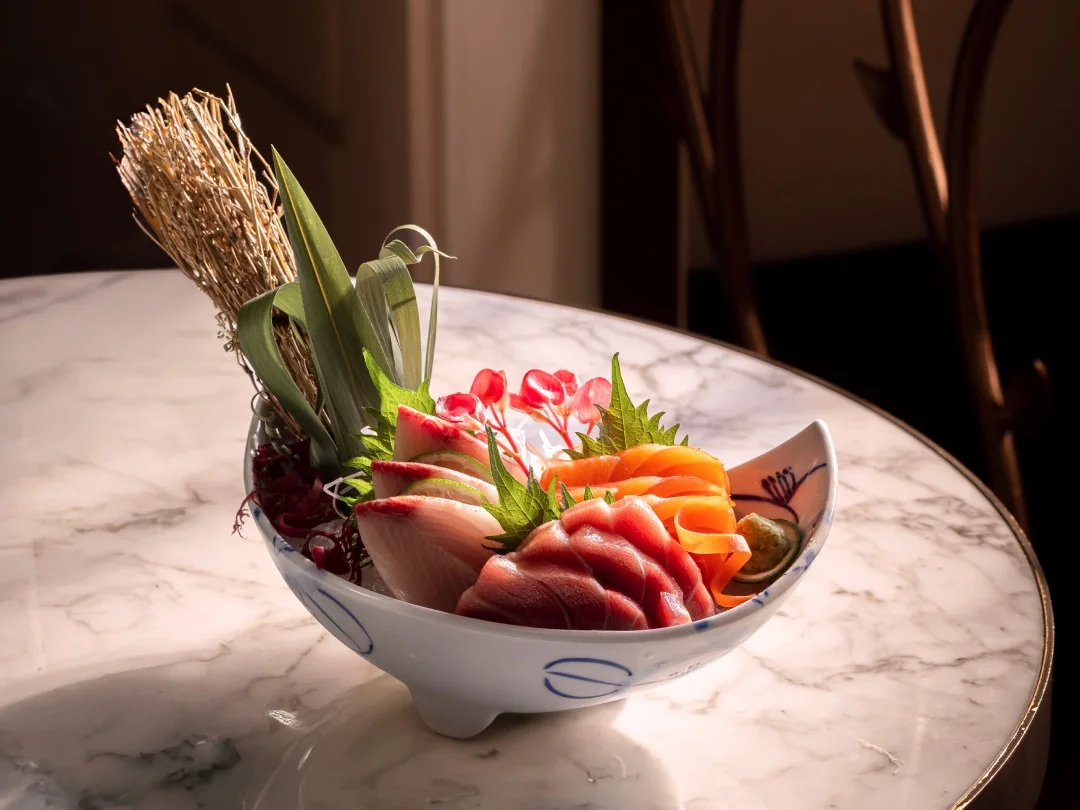
Ordering à la carte sashimi is satisfying. But the authentic way to experience it is omakase, a Japanese phrase meaning “I leave it up to you”. You surrender the decision‑making to the chef, who selects the best fish of the day and arranges it in the optimal tasting order. No menus. No deliberation. Just the kitchen’s finest work, served at the right temperature in the right sequence.
At Aki, the sashimi omakase platter arrives with fresh root wasabi and 30‑year‑aged sashimi soya, two details that separate a good sashimi experience from a great one. The platter is available in three sizes: 9 pieces (£38.50), 15 pieces (£76.50), and 21 pieces (£104.50). The 21‑piece omakase is the definitive way to eat sashimi at Aki: it covers the full spectrum from tai to otoro, with ikura and caviar closing the sequence.
Explore sashimi omakase in London
Reserve Your Table
Sashimi in Marylebone. The tasting sequence is waiting.
From Portuguese blue fin tuna to Scottish salmon, every cut on Aki’s sashimi list is served with 30‑year‑old sashimi soya and fresh root wasabi, two ingredients no other London restaurant can claim.
What separates good sashimi from great sashimi
Not all raw fish qualifies as sashimi grade. The distinction is not marketing, it is food safety and craftsmanship, handled through every stage of sourcing and preparation. Here are the five markers that matter.
The Fish
Ikejime & provenance
Farmed salmon intended for cooking is not automatically sashimi grade. The best sashimi fish comes from wild or responsibly farmed sources, handled with ikejime, a traditional Japanese technique that preserves freshness by reducing stress at the point of catch. Aki’s Portuguese wild blue fin tuna and Scottish salmon are selected specifically for raw consumption, and the difference in flavour and texture is unmistakable.
The Soya
30‑year‑aged sashimi soya
Most restaurants serve standard soy sauce with their sashimi. Aki uses a 30‑year‑aged sashimi soya, darker, richer, more complex, with none of the harsh saltiness that overwhelms delicate fish. A single drop is enough. This is not a condiment; it is an ingredient.
The Wasabi
Fresh root, not paste
If your wasabi is uniformly green, smooth, and burns your sinuses, it is almost certainly horseradish paste coloured with spirulina. Fresh root wasabi is pale green, fibrous, and sweet. It tingles briefly then fades, leaving the flavour of the fish intact. This is what Aki serves, grated to order on a sharkskin grater.
The Knife
Yanagi‑ba precision
A yanagi‑ba, the traditional single‑bevel sashimi knife, cuts through fish without damaging cell walls. A clean slice means a clean mouthfeel. The knife work is invisible when it is done well, which is exactly the point.
The Temperature
8–10°C, never fridge‑cold
Sashimi served straight from the fridge is mute. The fish should rest at 8–10°C before slicing: cool enough to be fresh, warm enough to release flavour. A kitchen that understands this is a kitchen that understands fish.
Is Sashimi Safe?
Parasites, freezing & what “sashimi grade” actually means
The question of parasites is the one every sashimi newcomer asks, and it deserves a straight answer. In the UK, fish intended for raw consumption must be frozen to -20°C for at least 24 hours (or -35°C for 15 hours) before serving. This kills any parasites present. “Sashimi grade” is not a legally regulated term, it is a supplier’s guarantee that the fish has been handled to standards safe for raw consumption. Reputable Japanese restaurants work with specialist suppliers who follow these protocols. Farmed Scottish salmon, for statistical purposes, carries a negligible parasite risk compared to wild‑caught fish, one reason it is among the most popular fish for sashimi in the UK. Gordon Ramsay once noted that he eats raw fish only at restaurants he trusts implicitly. The same logic applies: choose a kitchen that takes sourcing seriously, and the risk is functionally zero.
How to eat sashimi: etiquette that matters
Sashimi has its own rules, distinct from sushi etiquette. Here is how to eat it like someone who knows.
Chopsticks
Never fingers
Unlike nigiri, which can be eaten with hands, sashimi is always eaten with chopsticks. This is the first rule and the most fundamental.
Wasabi
On the fish, not in the soy
This is the single biggest tell of a beginner. Place a small piece of wasabi directly on the fish, then dip the fish, fish‑side down, into the soy sauce. Never drown it. The soy is a seasoning, not a bath.
Ginger
Palate cleanser between fish
Gari (pickled ginger) is a palate cleanser. Eat a thin slice between different types of sashimi to reset your mouth. Never place it on top of the fish.
One Bite
The whole piece
Each slice of sashimi is cut to be eaten in a single mouthful. The texture of the fish is as important as the flavour, and cutting a piece in half disrupts it.
Tasting Order
Lean to fatty, white to roe
White fish first (tai, suzuki). Silver fish next (saba). Red fish after that (akami). Fatty fish to follow (chutoro, otoro, salmon, hamachi). Roe and caviar last. This sequence ensures every piece tastes as it should.

What to drink with sashimi: sake, wine & Kiyori cocktails
Sashimi asks for a different kind of pairing than cooked food. The flavours are delicate; the drink should lift, not crush.
A rich, aged kimoto junmai sake mirrors the umami of otoro, the depth of the aged soya finding its equal in the glass. For hamachi and sea bass, a crisp daiginjo with floral notes keeps the palate clean. Cold Japanese beer, Sapporo or Asahi, is the correct counterpoint to fatty salmon sashimi: cold, bitter, and resetting. For the ikura and caviar, something bright and acidic cuts through the salinity: a yuzu sake from Kiyori’s vault bar, or a glass of Champagne if the evening calls for it. And if mackerel is on your plate, a Japanese whisky highball is the unexpected answer; smoke meets oil, and it works.
Explore the full wine list and Kiyori cocktail menu.
For Japanese food lovers, sashimi is the tell
If you judge a Japanese restaurant by the details, the temperature, the timing, the way a knife moves through fish, sashimi is not just a dish. It is a tell. It reveals whether the kitchen understands restraint, trusts its ingredients, and can deliver flavour without noise. Most Japanese restaurants in London serve sashimi. Very few serve it with 30‑year‑aged soya, fresh root wasabi, and Portuguese wild blue fin tuna on the same plate.
From the akami to the otoro, the hamachi to the saba, every slice out of Aki’s sashimi section is a quiet masterclass in control. There is no sauce to hide behind. Only the fish, treated with the respect it deserves.
Aki is a contemporary Japanese restaurant at 1 Cavendish Square, Marylebone, London W1G 0LA, a short walk from Oxford Circus and Bond Street. Open Thursday to Saturday from 12pm to 2am, and Sunday to Wednesday from 12pm to 11pm. Dinner is served daily from 5:30pm, with last orders at 10pm. Advance booking is recommended — reserve your table at Aki online.
Reserve Your Evening
Sashimi in Marylebone. Your table is waiting.
Step away from standard Japanese dining. Join us at 1 Cavendish Square for London’s finest sashimi, Portuguese blue fin tuna, Scottish salmon, 30‑year‑aged soya, and a wine list that turns a good dinner into a definitive one.
Frequently asked questions about sashimi
Everything you need to know before ordering sashimi at Aki
What is the difference between sushi and sashimi?
Sushi includes vinegared rice; sashimi is raw sliced fish served alone. Nigiri is fish on rice. Maki is rolled sushi. Sashimi is the fish, nothing else, just soy sauce, wasabi, and pickled ginger on the side.
Is sashimi always raw fish?
Almost always, but not exclusively. Some sashimi styles include briefly seared or cured fish. Chicken sashimi exists in parts of Japan, a thin slice of chicken breast briefly blanched and served raw in the centre, but it is extremely rare and not served at Aki.
What is the safest sashimi to order?
Farmed Scottish salmon and tuna are among the safest sashimi options. Both are subject to strict freezing protocols that eliminate parasites. Always eat sashimi at reputable Japanese restaurants that work with specialist suppliers.
What are the three cuts of tuna sashimi?
Akami (lean, deep red, from the back), chu toro (semi‑fatty, from the belly‑shoulder transition), and otoro (fatty belly, pale pink, the most prized and expensive cut).
What is sashimi omakase?
Omakase means “I leave it to you”. A sashimi omakase is a chef‑selected platter of the day’s best fish, arranged in the optimal eating order. At Aki, omakase platters come in 9, 15, or 21 pieces, all served with fresh root wasabi and 30‑year‑aged sashimi soya.
How should sashimi be eaten properly?
Use chopsticks. Place wasabi on the fish. Dip fish‑side down into soy sauce, lightly. Eat each piece in one bite. Cleanse your palate with pickled ginger between different fish. Follow the tasting order: white fish → silver fish → red fish → fatty fish → roe.
What is shiso leaf and why is it served with sashimi?
Shiso leaf is a Japanese herb with a minty, slightly spicy flavour. It is sometimes served under sashimi slices as both a garnish and an edible separation layer. It also has mild antibacterial properties, which historically made it a practical accompaniment to raw fish.