
Authentic sushi in London? 5 signs you’ve found the real thing
Finding authentic sushi in London is harder than it should be. Too many restaurants promise Japanese precision, then serve fridge-cold...
Finding authentic sushi in London is harder than it should be. Too many restaurants promise Japanese precision, then serve fridge-cold rice, horseradish paste, and fish hidden under spicy mayo.
Every piece of sushi at our Marylebone restaurant is built on four fundamentals: warm Edomae-style rice seasoned with aged akasu, fish sourced by provenance not convenience, fresh root wasabi grated to order, and 30-year-aged sashimi soy brushed on with precision. Nigiri from £8, omakase from £24. No theatre required.
At Aki, authentic sushi means
The four fundamentals that separate real craft from convenience
Most sushi in London is built for speed. Aki’s is built for flavour. The difference comes down to four decisions most kitchens will not make because they cost too much, take too long, or require skills that cannot be learned from a manual. Warm Edomae-style rice seasoned with aged red vinegar. Fish sourced by provenance, not price. Fresh root wasabi grated to order on a sharkskin grater. And 30-year-aged sashimi soy — worth more millilitre for millilitre than single malt whisky — brushed onto each piece with the restraint of a bartender pouring a vintage spirit. These are not garnishes. They are the architecture of the dish.
- Warm, seasoned rice: Edomae style with aged akasu, shaped to order at body temperature — never fridge-cold, never pre-formed in batches
- Fish by provenance: Portuguese wild bluefin tuna, Scottish salmon, Japanese hamachi — every piece traceable to its source
- Fresh root wasabi: grated per serving on a sharkskin grater — not the green horseradish paste served at 95% of London sushi counters
- 30-year-aged sashimi soy: applied with precision by the chef before the piece reaches you — no dipping required, no soy bath, no hiding the fish
- Omakase from £24: chef’s choice nigiri and sashimi platters spanning 6 to 32 pieces, each sequence built around the day’s best catch
Sushi in Marylebone: our menu at a glance
Everything on our sushi menu is prepared to order. Edomae nigiri, sashimi platters, maki rolls, and omakase, all brushed with 30-year soya and served with fresh wasabi.

5 signs of authentic Edomae sushi in London
Many people searching for the best sushi in London are not looking for spectacle. They are looking for excellent technique, thoughtful sourcing, and a dining experience grounded in craft rather than performance. Here is what to look for.
Rice temperature
Warm, seasoned sushi rice, not fridge-cold
Authentic Edomae sushi rice is served close to body temperature, never chilled. It should be seasoned with rice vinegar, sugar, and salt. In traditional Edomae style, aged red vinegar (akasu) adds depth that standard seasoning cannot replicate. Cold rice is the fastest way to spot a sushi counter cutting corners.
At Aki: Every piece of nigiri is shaped to order with warm, akasu-seasoned Japanese rice. The temperature, the texture, and the seasoning are treated as seriously as the fish itself.
Fish provenance
Fish prepared with skill, not just labelled “fresh”
The best sushi chefs age, cure, or marinate fish to deepen umami. “Fresh” is not a synonym for “best”, it is the starting point. A serious sushi restaurant can tell you exactly where the fish came from and how it was handled, because provenance matters as much as the cut.
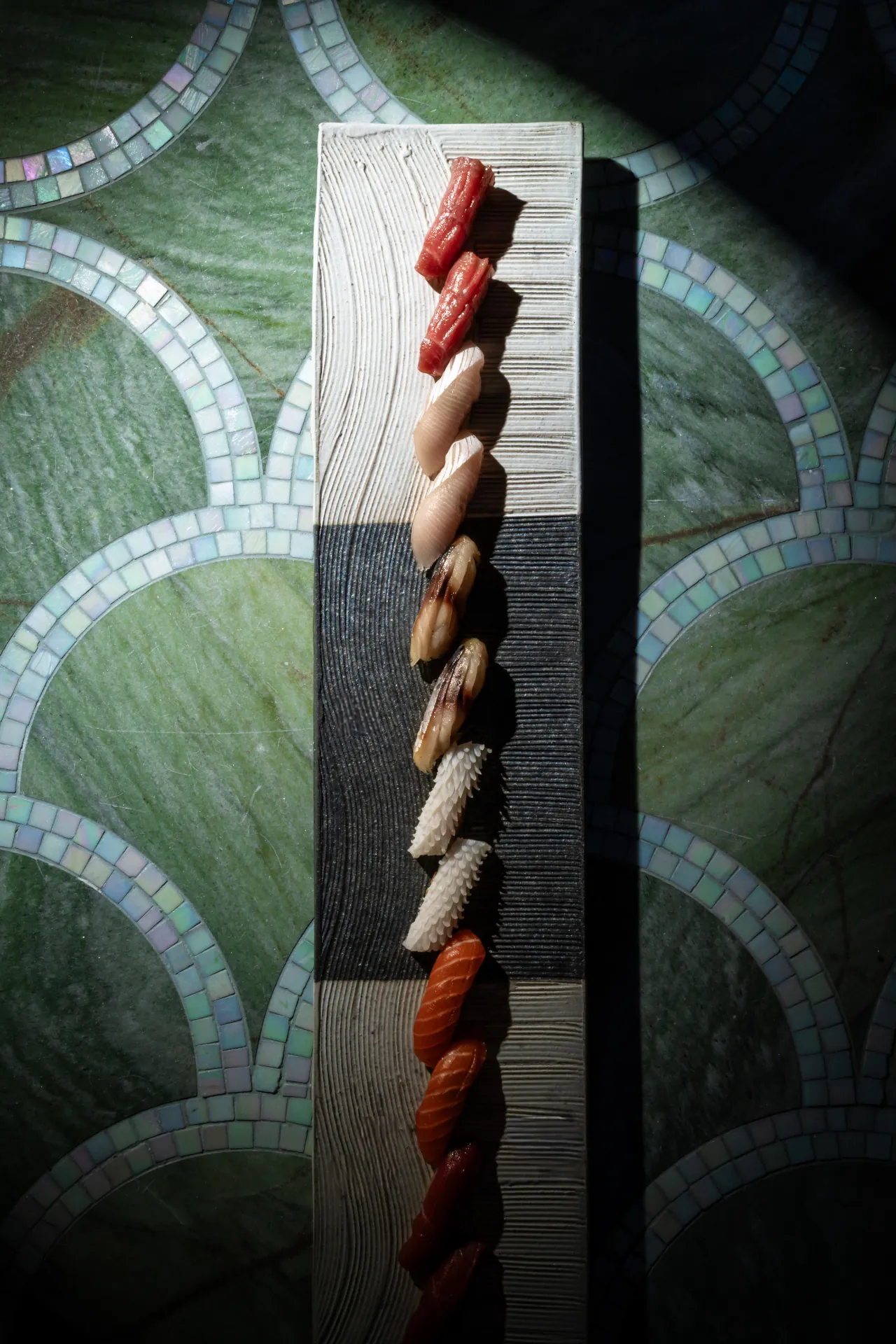
At Aki: Portuguese wild bluefin tuna (akami, chu toro, otoro), Scottish salmon, hamachi, sea bass, saba, and ikura. Our chefs will tell you the provenance of every piece on your plate.
Real wasabi
Fresh root wasabi, not green horseradish paste
That bright green paste served at most London sushi spots is usually horseradish, starch, and food dye. Real wasabi is subtle, fragrant, expensive, and must be grated to order. If a restaurant fakes the wasabi, ask yourself what else they are faking.
At Aki: Fresh root wasabi, grated per serving. It lifts the fish without overpowering it, exactly as it should.
Soy balance
Aged soy applied with restraint, not a soy bath
Heavy sauces, spicy mayo, sweet glazes, and excessive soy often hide mediocre fish. Authentic Edomae sushi needs at most a light brush of quality soy, applied by the chef before the piece reaches you. No dipping required.
At Aki: We use 30-year-aged sashimi soy, brushed onto each piece with precision. The flavour is already balanced. You do not need to add anything.
Chef’s choice
Omakase: the ultimate trust signal in Japanese dining
When a sushi restaurant offers omakase (chef’s choice), they put their reputation on the line. No hiding behind a menu, no substitutions, no safety nets. Just the chef’s judgement, the day’s best fish, and the skill to sequence a meal that tells a story.
At Aki: Our omakase nigiri platter (6, 18, or 32 pieces) and sashimi platter (9, 15, or 21 pieces) are journeys through the best of the day’s catch, brushed with 30-year soya and served with fresh wasabi.
Why authentic sushi is harder to judge than you think
One reason diners get confused is that the word “sushi” in London now covers everything from quick lunch sets to luxury omakase. Sushi rolls, spicy toppings, and heavily dressed plates all have their place, but they are not the best way to judge traditional Japanese technique.
If you want the best sushi London has to offer, start with the fundamentals. The strongest sushi restaurant does not need to hide behind excess because the rice, the fish, and the balance already do the work. Authenticity in Japanese food is not about stiffness or ritual for its own sake. It is about precision, restraint, and a deep understanding of a centuries-old tradition.
Experience authentic Edomae sushi
Warm akasu-seasoned rice, fresh root wasabi, 30-year-aged soya, and omakase crafted by chefs who respect the craft.
Every piece prepared to order at 1 Cavendish Square, Marylebone.
Authentic sushi vs typical London sushi: how Aki compares
A strong sushi chef understands that rice is the foundation of the entire meal. The best sushi restaurant does not need to hide behind excess because the rice, fish, and balance already do the work. Here is how that philosophy translates into practice at our Marylebone counter.
Typical London sushi
What usually goes wrong
- Cold, pre-formed rice shaped in batches
- “Fresh” as the only descriptor for fish
- Green horseradish paste passed off as wasabi
- Heavy sauces covering the fish
- Omakase either absent or an afterthought
Authentic sushi at Aki
What real care looks like
- Warm rice, shaped to order, seasoned with aged akasu
- Portuguese bluefin, Scottish salmon, hamachi, provenance on every plate
- Fresh root wasabi, grated per serving
- 30-year-aged soy, brushed with restraint
- Dedicated omakase: 6 to 32 pieces
Authentic sushi is part of a larger Japanese dining experience
A serious Japanese restaurant shows its standards across the entire menu, not just in one perfect piece of nigiri. The same discipline that produces warm, properly seasoned rice and precisely cut sashimi should also appear in the robata grill, the tempura, the broth, and the broader rhythm of the meal.
That matters because Japanese cuisine is ultimately about harmony. A restaurant can serve a delicious piece of fish and still miss the deeper logic of balance, sequence, and restraint that defines the best Japanese dining. The strongest kitchens carry the same attention across every section of the menu, from the sushi counter to the hot dishes to the final course.
At Aki, that means sushi and sashimi prepared with care alongside robata-grilled black cod, wagyu selected for marbling and texture, and tempura that prioritises lightness over batter. It is a more complete expression of Japanese cuisine, served in a dining room that holds its atmosphere without demanding attention. No wonder Aki was recently featured in Condé Nast Traveller’s roundup of the best sushi in London, a recognition that reflects our focus on ingredient quality, balance, and Japanese technique across the full menu.
Beyond the sushi counter: robata, brunch, and late-night cocktails in Marylebone
For anyone searching for authentic sushi in central London, the question is rarely just about the fish. It is about whether the restaurant understands what to do with it, and whether that understanding runs through the entire kitchen, not just one section of the counter. Beyond the sushi counter, Aki’s Japanese brunch in Marylebone offers a weekend ritual built around sharing plates and unlimited temaki hand rolls, while the unique cocktails in London served in our Kiyori lounge provide a late-night counterpart to the precision of the sushi counter. For the complete picture of what a Japanese cuisine restaurant in London can be, Aki delivers across every course and every hour of service.
Aki is a contemporary Japanese restaurant at 1 Cavendish Square, Marylebone, London W1G 0LA, a short walk from Oxford Circus and Bond Street. The sushi counter is open daily from midday until late, serving Edomae nigiri from £8, sashimi with 30-year-aged soya, and omakase platters from £24. Open Thursday to Saturday from 12pm to 2am, and Sunday to Wednesday from 12pm to 11pm. Advance booking is recommended — reserve your sushi table at Aki online.
Reserve your table
Authentic Edomae sushi in Marylebone. Every piece prepared to order.
Warm Edomae rice, fresh wasabi, 30-year soya, and omakase that respects the craft. At 1 Cavendish Square, Marylebone.
Frequently asked questions about authentic sushi at Aki
Everything you need to know before visiting our sushi counter in Marylebone
What makes sushi authentic?
Authentic sushi is defined by four fundamentals: warm, properly seasoned rice (in Edomae style, seasoned with aged red vinegar or akasu), fish sourced by provenance rather than convenience, fresh root wasabi grated to order, and quality soy applied with restraint rather than poured indiscriminately. At Aki, we use 30-year-aged sashimi soy brushed onto each piece by the chef before it reaches you. If a restaurant serves fridge-cold rice, green horseradish paste, and fish hidden under spicy mayo, it is prioritising speed and cost over craft.
What is Edomae sushi?
Edomae means “in front of Edo” and refers to the Tokyo Bay style of sushi dating to the 19th century. It is defined by three practices: fish that is cured, marinated, or lightly cooked rather than simply served raw; rice seasoned with aged red vinegar (akasu); and each piece of nigiri brushed with soy by the chef rather than dunked by the diner. At Aki, our nigiri section header reads: “Edo style, aged akasu brushed with 30yo sashimi soya.” This is not generic sushi — it is a specific historical tradition. Explore our omakase philosophy.
Is the wasabi at Aki real?
Yes. We serve fresh root wasabi, grated to order on a traditional sharkskin grater (oroshi). Approximately 95% of the “wasabi” served outside Japan is actually horseradish paste with mustard flour and green food colouring. Real wasabi (Wasabia japonica) costs £150–£250 per kilogram wholesale, has a subtle, fragrant heat that hits the nose rather than the tongue, and must be used within 15–20 minutes of grating. It enhances fish without masking it — the opposite of the sinus-burning green paste served at most London sushi counters.
What is 30-year-aged soy and why does it matter?
Our 30-year-aged sashimi soy is exactly what it sounds like: soy sauce aged for three decades, often in cedar barrels. The ageing process develops profound umami depth, caramel viscosity, and a complexity that industrial soy — produced in days — can never approach. It is the Japanese equivalent of 30-year balsamic vinegar. At Aki, it appears on eight separate dishes, from the Blue Fin Tuna Tartare to every piece of nigiri and sashimi. It is brushed on with the precision of a bartender pouring a vintage spirit. A single drop is enough.
What is omakase and how does it work at Aki?
Omakase means “I leave it up to you” — the chef selects each piece based on what is at peak seasonality that day and arranges it in the optimal tasting order. At Aki, omakase is available as a nigiri platter (6 pieces £24, 18 pieces £70, 32 pieces £115) or a sashimi platter (9 pieces £38.50, 15 pieces £76.50, 21 pieces £104.50). Every platter is served with fresh root wasabi and 30-year-aged sashimi soya. Learn more about omakase at Aki.
How much does sushi cost at Aki?
Edomae nigiri starts at £8 for two pieces. Sashimi (three pieces per order) starts at £9. Maki rolls range from £16 to £27. Omakase nigiri platters run from £24 (6 pieces) to £115 (32 pieces), and sashimi omakase from £38.50 (9 pieces) to £104.50 (21 pieces). The full sushi menu is available to view here.
What fish is on the sushi menu at Aki?
Our sushi counter features Portuguese wild bluefin tuna (akami, chu toro, and otoro), Scottish salmon, Japanese hamachi (yellowtail), seabream (tai), sea bass (suzuki), mackerel (saba), ikura (salmon roe), Oscietra caviar, unagi (freshwater eel), and Miyazaki beef. Every piece is traceable to its source — ask your chef about provenance when you order.
Was Aki really named one of the best sushi restaurants in London?
Yes. Aki was featured in Condé Nast Traveller’s roundup of the best sushi in London, recognised for our focus on ingredient quality, balance, and Japanese technique across the full menu. The restaurant is also listed in the Michelin Guide.
Do I need to book a table for sushi at Aki?
Advance booking is recommended, particularly for evenings and weekends. The sushi counter is open daily from midday until late. Reserve your table at Aki online.